US Stocks Under Pressure, HK Stocks Strong: Structural Market Opens New Chapter
Introduction
After a period of high volatility in the first quarter, global capital markets are entering a delicate reassessment phase. Last Friday, the three major US stock indices all closed lower, with tech stock weakness and fading market sentiment forming a resonance. On the other side of the Pacific, Hong Kong stocks opened higher against the trend this morning, with the Hang Seng Index, Hang Seng Tech Index, and Hang Seng China Enterprises Index all strengthening, and sectors including tech, biomedicine, and gold showing multi-point gains. This divergence is not accidental but the inevitable result of the rebalancing of global capital flows, the valuation trough effect, and the resonance of industrial cycles. This article combines the latest market data to provide an in-depth analysis of the operational logic of current global capital markets and looks forward to subsequent structural opportunities in Hong Kong stocks.
1. Three Pressures Behind US Stock Correction
The mild decline in US stocks last Friday was seemingly triggered by the cooling of tech stock sentiment following reports that OpenAI plans to postpone its listing plan, but the deeper reasons are more complex. First, the tech sector, led by AI, after experiencing sharp gains over the past half year, is at historically high valuations, and any negative news can trigger profit-taking. OpenAI, as a benchmark company in the current AI wave, the delay in its listing process directly shook market expectations for the pace of tech stock earnings realization. Second, although the US 10-year Treasury yield has fallen back to around 4.36%, it remains in a high range overall, continuing to suppress the valuation of growth stocks. Third, the repeated decline of the US dollar index reflects both the market's repricing of the pace of Fed rate cuts and suggests the beginnings of global capital shifting from USD assets to emerging markets.
Notably, gold prices rebounded at low levels while oil prices continued to be under pressure, a contradictory set of signals revealing capital's alert to "stagflation" risk: on one hand, fears that inflation stickiness will keep interest rates high; on the other hand, anxiety about demand decline brought by economic slowdown. In this macro background, US stocks lack systemic upward momentum, and structural divergence will be the main theme.
2. Hong Kong Stocks Open Higher: Valuation Trough Attracts Capital Replenishment
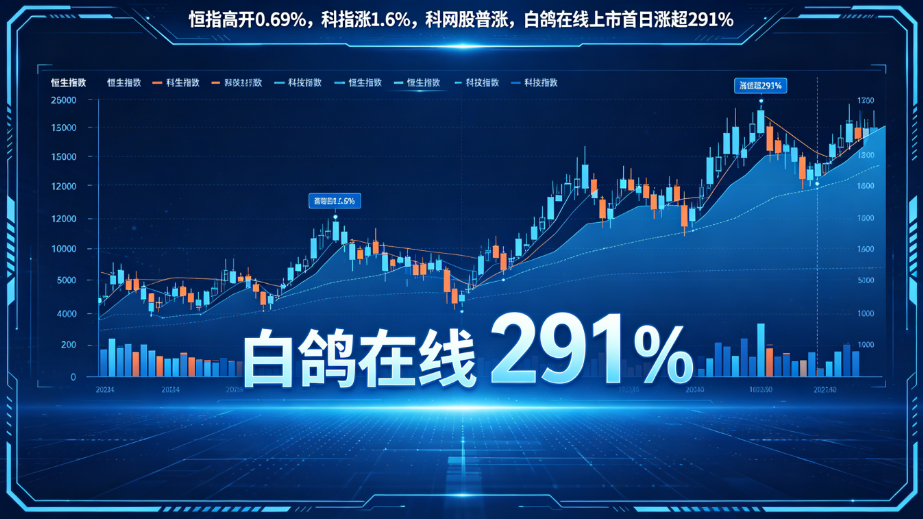
Today, the three major HK stock indices all opened higher, with the Hang Seng Index up 0.69% at 22,827.65 points, the Hang Seng Tech Index up 1.6%, and the Hang Seng China Enterprises Index up 1.03%. This trend contrasts sharply with US stocks. The fundamental reason is that the current valuation level of Hong Kong stocks has a clear safety margin compared to US stocks. The Hang Seng Index's price-to-earnings ratio has long been lower than major global markets, while the components of the Hang Seng Tech Index, after undergoing deep adjustments in the previous two years, have fully tested their profitability and business models, highlighting their cost-performance advantage.
From the sector performance, tech stocks generally strengthened: NetEase rose over 4%, Baidu up 4%, Meituan and JD.com up over 3%. These leading companies' layouts in AI applications, local life services, and retail digitalization are entering the harvest period, and the turmoil in US tech stocks has actually accelerated global capital's reallocation to similar targets in Hong Kong. At the same time, biomedical stocks opened higher, with WuXi Biologics up over 2%, indicating that market pessimism about innovative drugs and CXO chains is being repaired, and the dual benefits of policy marginal improvement and capital backflow are gradually emerging. Gold stocks were active, with China Gold International up over 1%, directly related to the gold price rebound and reflecting market demand for safe-haven assets.
The performance of today's three newly listed stocks further ignited market sentiment: Rightful Pharma-B surged over 85%, Hai Guang Xin Zheng rose over 75%, and Baige Online surged over 291%. Such high first-day gains indicate, on one hand, capital's strong thirst for quality new stocks, and on the other hand, suggest that the primary market financing function of Hong Kong stocks is recovering, paving the way for more innovative tech companies to list in the future. The high opening of these new stocks is essentially a signal that the market is revaluing the HK stock valuation system — when existing stocks are undervalued, new stocks priced reasonably naturally attract large amounts of capital to participate.
3. Resonance of Macro Environment and Capital Flows
From a broader perspective, today's strength of Hong Kong stocks is not a single-day effort but the result of multiple factors overlapping. First, although the repeated anticipation of Fed rate cuts keeps US Treasury yields high, the People's Bank of China's monetary policy maintains a steady and loose stance, reducing the systemic risk of HK stock liquidity. Second, the RMB exchange rate stabilized during the dollar's decline, reducing the hedging cost for foreign capital entering and exiting Hong Kong stocks. Third, geopolitical risks have entered a period of relative calm, and capital's risk appetite for emerging markets represented by China has rebounded.
Notably, the US 10-year bond yield fell back to 4.36%, although still high in absolute terms, the marginal downward trend provides relative attractiveness for Hong Kong stocks, especially high-dividend sectors. At the same time, international oil prices continue to be under pressure, impacting oil-exporting countries, but for resource-importing countries like China, it means reduced imported inflation pressure, benefiting corporate profit improvement. This macro combination creates favorable conditions for the structural market in Hong Kong stocks.
4. Future Outlook: Structural Opportunities Outweigh Systemic Risks
Looking ahead, the trend of Hong Kong stocks will show characteristics of "index fluctuations, stock divergence, and sector rotation." In the short term, the Hang Seng Index faces certain pressure at the 23,000-point integer level, but the room for correction is limited because traditional sectors such as finance, real estate, and energy have low valuations, providing support for the index. In the medium term, growth sectors such as tech, biomedicine, and consumer electronics are expected to stage independent trends driven by earnings growth.
In terms of operational strategy, investors should focus on three main lines: first, AI applications and platform economy — companies like NetEase and Baidu have already shown strong monetization capabilities; second, innovative drugs and medical devices — policy support combined with aging population-driven rigid demand, industry prosperity is expected to rebound; third, gold and resource stocks — under persistent global uncertainty, precious metals still have allocation value. For the new stock market, attention can be paid to quality targets with reasonable pricing, but caution is needed regarding short-term correction risks after excessive first-day gains.
Conclusion
The divergence between US stocks under pressure and HK stocks strong is essentially a manifestation of global capital performing "valuation correction" between different markets. When USD assets become less attractive due to high valuations, Hong Kong stocks, with their triple advantages of low valuation, high growth, and policy friendliness, are gradually becoming one of the priority choices for global capital reallocation. In the short term, the market will still be disturbed by external factors such as US Treasury yield fluctuations and geopolitical events, but in the medium to long term, the structural opportunities in Hong Kong stocks are emerging. Investors should remain rational, select stocks carefully, and welcome the new round of structural market with a steady allocation strategy.