US Urges Korean Semiconductor Giants to Expand: Strategic Game Amid AI Chip Shortage
Keywords: AI chip shortage; US semiconductor policy; Samsung Electronics; SK Hynix; capacity expansion; supply chain security
Introduction
Amid the global AI industry wave, a game over high-end chip capacity is unfolding on the international stage. Recently, the US Commerce Secretary publicly urged Korean semiconductor giants Samsung Electronics and SK Hynix to expand capacity in the US to ease the increasingly severe AI chip shortage. This move not only reflects Washington's urgent intent to reshape the semiconductor supply chain but also reveals the profound impact of surging AI computing demand on the global memory chip landscape. For Samsung and SK Hynix, responding to the US call presents both opportunities and challenges—how to make wise choices balancing technology leadership, capacity layout, and geopolitical risks will be key to determining the future direction of the global semiconductor industry.
Main Body
1. AI Chip Shortage: From Computing Hunger to Storage Bottleneck
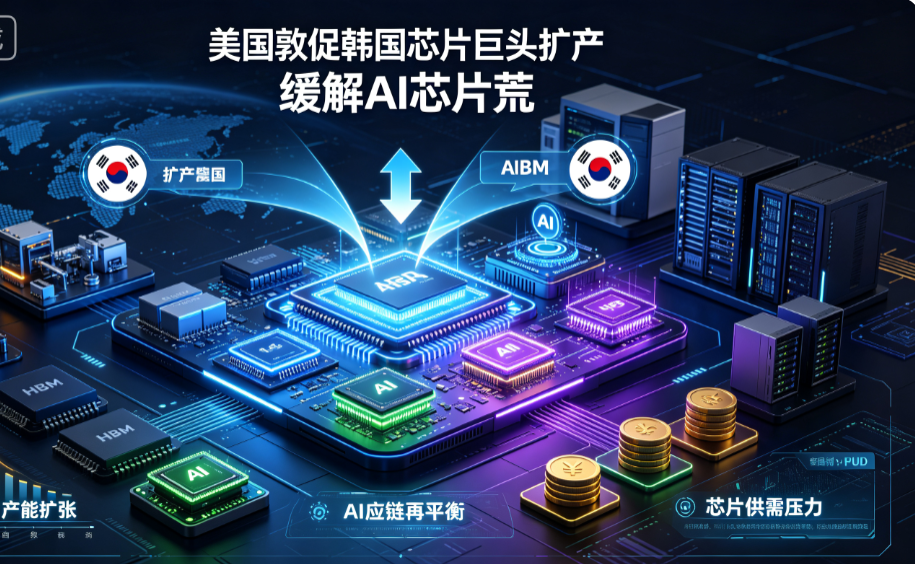
Currently, training and inference of AI large models demand exponential growth in computing resources. Whether OpenAI's GPT series or large-scale AI systems of Google and Meta, they rely on massive GPU clusters and high-performance storage chips. However, supply chain fragility has been exposed in recent years: advanced logic chips (e.g., Nvidia H100, B200) are tight, but the more critical storage chip—high-bandwidth memory (HBM)—has become a bottleneck.
HBM is a storage solution that tightly couples DRAM chips with GPUs via 3D stacking, offering bandwidth far exceeding traditional DDR memory, making it indispensable for AI accelerators. Currently, only three companies globally can mass-produce HBM: Samsung Electronics, SK Hynix, and Micron, with the first two Korean firms dominating, holding over 80% combined market share. As AI server shipments continue to rise, the HBM supply-demand gap widens, even leading to a situation where chips are harder to find. The US Commerce Secretary's public call is based on this reality: while the US leads in AI chip design, it heavily relies on East Asia—especially Korea—for storage chip manufacturing.
2. Urgency of US Semiconductor Strategy: CHIPS Act and Localization Demands
Since the passage of the CHIPS and Science Act in 2022, the US government has been working to bring advanced semiconductor manufacturing back home to reduce dependence on Asian supply chains. The act offers up to $52.7 billion in subsidies and tax incentives for companies building fabs in the US, aiming to establish at least two advanced logic chip clusters by 2030. However, memory chip layout has lagged: while Micron has announced billions in investments in New York and Idaho, the two Korean giants primarily keep their capacity in Korea.
Against this backdrop, the Commerce Secretary's urging is no coincidence. On one hand, the AI chip shortage directly affects US tech giants' computing power deployment, weakening their competitiveness in the global AI race. On the other hand, geopolitical risks—especially uncertainty over the Taiwan Strait—force Washington to prepare for worst-case scenarios. If the East Asian supply chain is disrupted by a sudden event, the US AI industry would face a severe predicament. Thus, persuading Samsung and SK Hynix to set up advanced HBM production lines in the US has become a top priority for US semiconductor policy.
Notably, the Commerce Secretary specifically emphasized the phrase "ease AI chip shortage" in public, implying the US wants not just ordinary DRAM fabs but the most advanced HBM3E and even next-generation HBM4 capacity located in the US. This requirement is extremely challenging: HBM production requires highly sophisticated processes and mature ecosystems. Currently, SK Hynix's HBM lines are almost entirely in Icheon and Cheongju, Korea, while Samsung's are in Hwaseong and Pyeongtaek.
3. Samsung and SK Hynix's Choice: Opportunities, Costs, and Technology Moat
Facing the US call, Samsung and SK Hynix's responses will be carefully weighed. On the positive side, building fabs in the US brings multiple benefits: direct government subsidies reducing capital expenditure, proximity to end customers like Nvidia, AMD, and Intel, and avoidance of potential trade barriers such as tariffs or export controls on non-US chips.
However, challenges are equally significant. First, high construction costs: US labor, energy, and construction costs far exceed Korea's, with a shortage of skilled workers. It is estimated that building an advanced 300mm fab in the US costs 30% to 50% more than in Korea. Second, technology spillover risk: HBM core processes involve proprietary technologies like TSV and micro-bumps, and setting up fabs abroad means sharing some IP with local engineers and management. Third, policy uncertainty: the CHIPS Act subsidy process is complex, and differences between Republican and Democratic parties on industrial policy could lead to budget cuts or policy shifts.
At a deeper level, Samsung and SK Hynix must also balance strategic autonomy in global capacity layout. The Korean government has consistently emphasized the "national security" attribute of the semiconductor industry, requiring companies to retain core technology roots in Korea. If Samsung and SK Hynix deploy massive HBM capacity in the US, it could weaken Korea's position as a global memory hub and even cause concerns of industrial hollowing.
4. Geoeconomic Impact of Korea-US Semiconductor Cooperation
The US urging Korean companies to expand is not an isolated event but an extension of the US-led "Chip 4" alliance and "Indo-Pacific Economic Framework" in semiconductors. The deeper purpose is twofold: to build an advanced chip supply chain closed loop excluding China, and to ensure US absolute leadership in next-generation AI technology.
For Korea, deep binding with the US is both a security guarantee and an economic opportunity. The Korea-US alliance has been tested over years with deep cooperation in military and technology. However, over-reliance on the US market also carries risks: once Washington uses technology aid or market access as geopolitical leverage, Korea's industrial autonomy may be eroded. Moreover, China is the largest single semiconductor market for Samsung and SK Hynix, with Korean memory chip exports to China accounting for about 40% of total exports in 2023. If the US pushes hard for decoupling, Korean firms face a tough choice—cater to the US and sacrifice Chinese market share, or stay neutral and endure US pressure.
From a broader perspective, the AI chip shortage is fundamentally a global problem requiring collaborative solutions. The US unilaterally demanding Korean companies expand capacity may ease supply tension in the short term but cannot resolve the deep contradictions of over-concentrated supply chains and geopolitical fragmentation. A truly sustainable solution should promote multilateral cooperation, establish risk-sharing mechanisms, and encourage all major semiconductor players including China, Taiwan, Japan, and Europe to jointly invest in diversified capacity.
5. Future Outlook: Can Capacity Expansion Truly Ease the Shortage?
Even if Samsung and SK Hynix respond positively to the US call, the easing of the AI chip shortage remains uncertain. First, new fab construction typically takes 3-5 years, while AI demand may continue to surge during this period. According to industry forecasts, the HBM market will grow over fivefold by 2026, and even if all expansion plans are implemented, supply-demand balance may not be achieved until around 2028.
Second, technology iteration is rapid. HBM products update every 1.5 to 2 years; HBM3E has just entered mass production, and HBM4 standards are being set. If the US only asks Korean companies to build fabs for older processes, it will not meet future AI chips' strict bandwidth and power requirements. Therefore, the US must commit to supporting local production of the most advanced technologies, which involves sensitive technology transfer issues.
Finally, market forces will play a decisive role. Samsung and SK Hynix's capacity decisions are essentially business choices based on ROI. The US can offer subsidies and incentives but cannot guarantee long-term demand—if the AI bubble bursts or alternative technologies (e.g., optical interconnects, in-memory computing) emerge, huge investments could become sunk costs. Hence, expansion plans will inevitably be phased and reserved.
Conclusion
The US Commerce Secretary urging Samsung and SK Hynix to expand US capacity is both a direct reflection of the AI chip shortage crisis and a key scene in the reshaping of global semiconductor supply chains. For the US, this move aims to build a safer, more resilient AI chip ecosystem starting with memory; for Korean companies, it is a major strategic choice—while enjoying US policy benefits, they must consider costs, technology moats, and the balance with their core market, China.
In the long run, solving the AI chip shortage cannot rely on a single country's administrative orders or a few companies' capacity expansion. It requires international cooperation to drive technology collaboration, optimize resource allocation, and address geopolitical distortions. Only by building a diversified supply system on an open cooperation foundation can humanity overcome the "chip bottleneck" and truly unleash AI's transformative potential. In this process, Samsung and SK Hynix, as the twin giants in memory, will see their every decision profoundly impact the global semiconductor landscape for the next decade.