U.S. Treasury Secretary Bessent Sends Policy Signals: Inflation Decline Anticipated, Fed Independence Respected
Recently, U.S. Treasury Secretary Bessent gave a speech and answered questions at the Economic Club of New York, systematically sharing his views on core issues such as the policy path of the new Fed leadership, inflation outlook, and economic diplomacy principles. As a key architect of the Trump administration's fiscal policy, Bessent's remarks not only reflect the current thinking of U.S. economic managers but also provide important clues for market participants to understand future policy direction.
New Fed Helmsman Receives Trust, Rate Cut Pressure May Hit Buffer
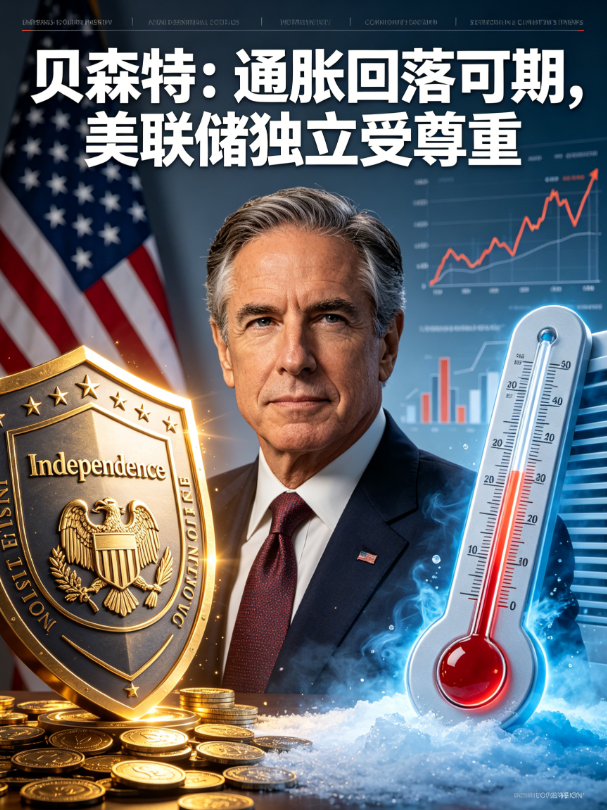
In the event, Bessent explicitly expressed confidence in new Fed Chair Kevin Warsh. He stated: "I believe the Fed chairman will optimize the policy path for inflation and economic growth." This statement is particularly noteworthy against the backdrop of the Trump administration's long-standing calls for rate cuts.
Since Warsh took office, his policy stance has been at the center of market focus. Last week, Warsh chaired his first FOMC meeting. Despite Trump's repeated public pressure for rate cuts, Warsh and other Fed officials voted to keep rates unchanged. Behind this decision lies the emergence of new inflationary pressures—core CPI persistently above the target level, leading policymakers to no longer be fixated on rate cuts, with some officials even seeing a need for higher borrowing costs in 2026.
Bessent did not show critical alignment with the president's position; instead, he provided a historical perspective to endorse Warsh's independence. He quoted Trump's remarks at Warsh's inauguration ceremony, saying Trump then clearly stated, "He will maintain independence." This approach of separating political pressure from institutional arrangements somewhat alleviated market concerns about the erosion of Fed independence.
More profoundly, Bessent borrowed a famous quote from Trump himself: "Bond markets have overthrown more governments than howitzers." This points to the political consequences that rising long-term borrowing costs driven by inflation can cause. Bessent analyzed that Trump understands this logic, so "I believe he (Trump) has full confidence that the Fed chairman can make the right decisions." This expression, uniting political interests with economic laws, both responds to speculation about executive interference and hints at the White House's clear awareness of the current inflation situation.
Easing Iran Tensions Support Inflation Decline Outlook
On the inflation outlook, Bessent gave a clear forecast: as U.S. and Iranian negotiators work to end the war, U.S. consumer price increases will slow. He said: "Now, I think we have passed this conflict, gasoline prices will fall, and inflation will return to target levels."
This judgment has a realistic basis. Since the U.S. and Israel took military action against Iran, global energy markets have experienced severe volatility, with crude oil prices briefly hitting multi-year highs, becoming a major factor driving U.S. inflation upward. However, recently the U.S. Senate passed a bill limiting the president's war powers, requiring Trump to end military operations against Iran. This is the first time the Senate has passed such a bill, marking a clear signal at the political level for easing tensions.
Bessent specifically mentioned the 60-day license issued for Iranian oil sales, calling it "generally beneficial to global markets" and part of the "negotiation process." The license allows some countries to continue importing Iranian oil for a limited time, effectively avoiding a supply cliff and providing a buffer for the market. From an economic perspective, this arrangement helps stabilize oil price expectations, thereby lowering end-consumer prices.
Notably, Bessent's expectation of inflation decline is not isolated optimism. He placed it within the framework of international geopolitical evolution, emphasizing that easing conflicts directly relates to lower energy costs. This logical chain highly aligns with the Fed's current policy dilemma—if inflation naturally declines due to external factors, the Fed doesn't need aggressive rate hikes to suppress demand, reducing the risk of a hard landing.
Redefining Economic Diplomacy Principles: National Security and Industrial Autonomy
In the main part of his speech, Bessent systematically articulated his view of U.S. economic diplomacy principles. He quoted the classic statement of the first U.S. Treasury Secretary, Alexander Hamilton: "Every nation ought to endeavor to have within itself all the essentials of national supply." This thought is exactly the core color of current U.S. economic policy—economic security begins with the ability to build, invent, finance, and develop the industries that will define the next century.
Bessent listed seven strategic industries: semiconductors, artificial intelligence, quantum computing, advanced manufacturing, shipbuilding, critical minerals, and pharmaceuticals, emphasizing that "these industries are not just economic sectors; they are sources of national power." He clearly stated that the U.S. must lead in all these areas. This statement actually revises the "globalization is optimal" philosophy that prevailed after the Cold War, instead emphasizing supply chain security and autonomous control.
When asked about the contradiction between pursuing a strong dollar and U.S. manufacturing competitiveness, Bessent gave a meaningful answer. He pointed out that the two are not in conflict. "When people talk about a strong dollar, I think it doesn't refer to the Bloomberg Dollar Index." He observed that the dollar has fallen since early last year. "I don't wake up and think, great, that helps the economy. I just think it's a number on a screen."
This statement reveals Bessent's pragmatic attitude toward dollar policy: he is not fixated on maintaining an absolutely strong exchange rate but is more concerned about the dollar's leadership position in the international financial system. He further explained: "Financial leadership is a core tool of state governance. The dollar's position in the world is no accident. America's leadership brings great advantages but also major responsibilities." Evading sanctions, financing terrorism, weapons of mass destruction proliferation, cybercrime, drug trafficking, and corruption all "exploit loopholes in the financial system." The Treasury's job is to protect the financial system by rooting out these abuses.
This line of thinking linking financial regulation to national security essentially continues the "financial enforcement power" logic that the Trump administration has gradually strengthened since its first term. Through fine-tuned control of cross-border payment systems, bank compliance systems, and sanctions enforcement mechanisms, the U.S. Treasury is upgrading the dollar system from a mere transaction medium to a geopolitical lever.
Conclusion: Finding Policy Anchors in Uncertainty
The core message of Bessent's speech can be summarized in three points: First, Fed independence is substantially respected by the White House, and inflation pressure will guide the rate path; second, easing Iran tensions is expected to alleviate energy price pressure, aiding inflation decline; third, U.S. economic diplomacy is undergoing structural transformation, with industrial autonomy and financial leadership becoming two pillars.
For market participants, these signals have both positive aspects and imply long-term challenges. In the short term, if oil prices fall as expected, reduced inflation pressure will ease the urgency for further Fed rate hikes, supporting risk assets. But in the long term, the exclusive tendency of U.S. industrial policy and the strengthening of financial regulation may reshape global supply chains and capital flow patterns, bringing new uncertainties.
Bessent's speech may not be a simple policy preview but a public declaration of U.S. economic governance philosophy: in the post-globalization era, the tension between security and efficiency, autonomy and openness will run through the entire economic decision-making process in the coming years. Whether Fed Chair Warsh can find balance between political pressure and inflation governance, whether the Iran situation can ease as expected, and whether U.S. economic diplomacy principles can be effectively implemented on the ground will all be key variables determining the final direction.