South Korea Gasoline Price Drops Below 2000 Won Threshold: In-depth Analysis of Market Mechanism, International Transmission, and Consumer Behavior
Keywords: South Korea; gasoline price; 2000 won; international oil prices; refining profit; consumer behavior; market transmission
Introduction
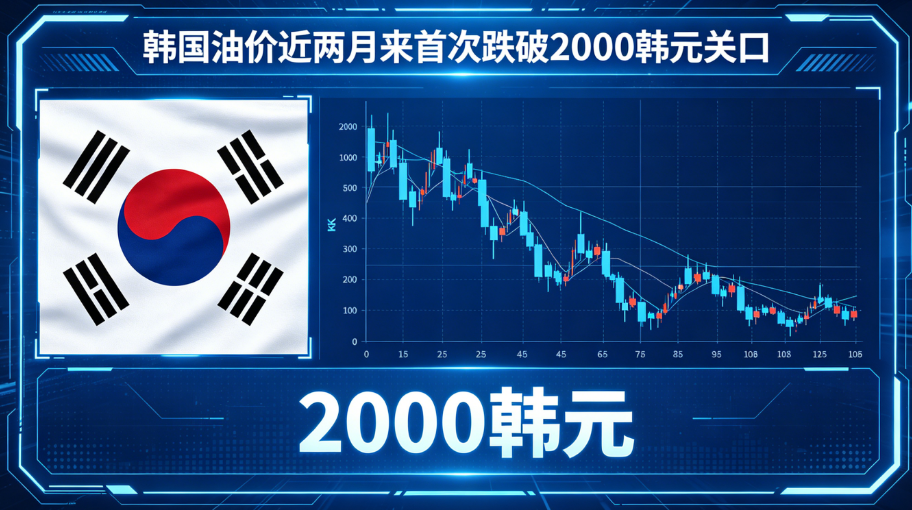
On an ordinary Sunday in March 2025, the average gasoline price at South Korean gas stations continued the previous day's decline, officially falling below the psychological threshold of 2,000 won per liter (about 1.3 USD), hitting a near two-month low. According to data from the Korea National Oil Corporation (KNOC), as of 9 a.m. that day, the average gasoline price was 1,991.1 won per liter, down 5 won from the previous day. This seemingly simple numerical change actually reflects the intertwined interplay of multiple forces in the global energy market: from the transmission of international crude oil price fluctuations to the hidden cost of the won exchange rate, from the profit game of oil refiners to the behavioral adjustment of end consumers. This article will technically dissect the market logic and structural factors behind this price phenomenon.
1. Data Interpretation: Symbolic Meaning and Market Psychology of the 2000 Won Threshold
In the Korean fuel market, the threshold of 2,000 won per liter is not only an arithmetic number but also a psychologically significant "anchor point." Since oil prices surged at the end of 2024, the 2,000 won level became a dividing line for consumers and industry observers to judge the market as "high" or "low." Breaking below this threshold means that Korean gasoline prices have officially entered the "1 era," triggering a chain reaction in consumer confidence, gas station pricing strategies, and government energy policies.
From a technical perspective, the average price published daily by KNOC is a weighted statistic based on actual transaction data from thousands of gas stations nationwide. Although the magnitude of change is small, the trend signal is clear. After the previous day's average price fell below 2,000 won, the market generally expected a brief "rebound watch" — some gas stations might maintain higher prices due to lagging cost declines, waiting for competitors to adjust. However, staying below that level for a second consecutive day suggests that the downward trend is persistent, not due to accidental factors. The daily decline of 5 won, although small in absolute terms, is enough to trigger extensive media coverage and a "herd effect" of consumers queuing to refuel in oil price-sensitive South Korean society.
2. International Oil Price Transmission Mechanism: Brent Crude and Korean Fuel Pricing
As the world's fifth-largest crude oil importer with virtually no domestic oil fields, South Korea's fuel prices are highly dependent on the international crude oil market, especially spot prices and forward contracts for Brent and Middle East Dubai crude. Changes in international oil prices have about a two-week lag in transmission to domestic gasoline prices — from crude oil procurement, shipping, to refinery processing, and then to wholesale and retail, each stage has a time difference of about 3 to 5 days.
Recently, Brent crude prices have been under pressure due to weak global demand and expectations of increased production by OPEC+, with the main contract price returning to around 70 USD per barrel, down about 12% from the beginning of the year. This decline is transmitted through the chain "crude oil → Singapore FOB → South Korea import CIF → refining cost → wholesale price → retail price," finally appearing at the terminal. Notably, KNOC data shows that the oil price drop below 2,000 won was not due to a single-day crash but the cumulative result of sustained small declines over several days, highly consistent with the "slow fall, sharp rise" characteristic of the international crude oil market — that is, in a declining cycle, oil prices often show a slow, continuous trend, while rises are more easily driven by sudden events and surge rapidly.
From the perspective of refinery profit, the gasoline cracking spread (the price difference between gasoline and crude oil) in the Singapore region has narrowed recently, from 12 USD per barrel to about 9 USD. This means that even if crude oil prices stabilize, Korean refineries' processing margins are shrinking, compressing the profit space for gas stations to purchase from wholesale markets. Therefore, although the decline in international oil prices is the main cause of this price drop, the retail decline is slightly smaller than the wholesale decline, reflecting the tail effect of refineries and gas stations absorbing some of the cost increases.
3. Won Exchange Rate and Import Costs: How Currency Factors Invisibly "Shave Peaks and Fill Valleys"
When analyzing Korean fuel prices, the dynamic impact of the won-to-dollar exchange rate cannot be ignored. South Korea imports crude oil mainly in USD, and fluctuations in the won often change the actual value of import costs in the short term. The current USD/KRW exchange rate is around 1,320 won per dollar, slightly depreciated compared to about 1,280 won per dollar a year ago. This depreciation of about 3% means that even if the dollar-denominated international oil price remains unchanged, the procurement cost for Korean refineries calculated in won will rise accordingly.
However, in this price reduction process, the won exchange rate actually played a "buffer" role — when international oil prices fell sharply, the won depreciation partially offset the magnitude of the price drop. In other words, if the won exchange rate were the same as last year, the pace of the average gasoline price falling below 2,000 won might have been faster and the magnitude larger. From this perspective, the current average price of 1,991.1 won actually includes a layer of "exchange rate tax": consumers have not fully enjoyed all the dividends of the international oil price decline because currency depreciation provides implicit support for import costs.
This mechanism is often overlooked in technical analysis but is crucial for understanding the medium- to long-term trend of the Korean fuel market. As long as the Fed maintains relatively high interest rates and the Korea-US interest rate differential persists, the pressure on the won exchange rate will not be easily relieved. This means that when oil prices rebound in the future, Korean consumers may face a magnified effect of "international oil prices rise 10%, domestic oil prices rise 12%."
4. Refining Industry Profit and Competition Landscape: The Game Level of Gas Station Pricing Strategy
South Korea has world-leading refining capacity, with the four major refineries — SK Energy, GS Caltex, S-Oil, and Hyundai Oil — controlling about 90% of the wholesale market. This highly concentrated industry structure gives refineries strong bargaining power in pricing. However, at the retail end, competition among gas stations is fierce: South Korea has about 12,000 gas stations, one of the highest densities in the world, and in recent years, the number of self-branded and discount stations (such as "self-operated gas stations" and "unbranded gas stations") has increased, breaking the original oligopoly control pattern of large enterprises.
An important technical factor behind the drop below 2,000 won this time is the acceleration of the "price follow strategy." When large gas stations take the lead in lowering prices to attract customers, surrounding small and medium-sized gas stations often follow within 24 hours to avoid losing customers. KNOC data shows that on the first day of the price drop, the number of price-cutting stations in densely populated areas such as Seoul and Gyeonggi Province was three times that in rural areas, indicating that competitive pressure mainly comes from demand-concentrated regions. In tourist areas like Gangwon Province, due to the tourism season not yet in full swing, some gas stations still maintain prices above 2,000 won, showing a feature of "regional price divergence widening."
In terms of profit structure, the current gross profit margin for South Korean gas stations is about 70 to 100 won per liter (including operating costs and taxes). When the retail price falls below 2,000 won, the gross profit narrows to about 50 won per liter, and some inefficient stations may incur losses. This in turn promotes industry consolidation: on one hand, large refineries gradually eliminate inefficient stations in remote areas through franchise operations and logistics subsidies; on the other hand, consumers' sensitivity to price increases further drives gas stations to transform toward a "low profit, high turnover" model.
5. Consumer Behavior and Demand Elasticity: The "Hidden Stimulus" of Low Prices on Consumption
From an economic perspective, gasoline demand lacks short-term price elasticity, meaning that a 10% price drop usually leads to a demand increase of less than 5%. However, the uniqueness of the South Korean market lies in its behavior patterns based on "resident travel frequency" and "refueling habits," making the role of psychological price points far greater than theoretical models. This drop below 2,000 won is likely to trigger a round of "emotional refueling" — many car owners will choose to fill up their tanks early, or switch from public transportation to driving to work.
According to research data from the Korea Automobile Association, when gasoline prices fall below 2,000 won, the average monthly refueling frequency of small car owners increases from 3.8 times to 4.2 times, and the average refueling volume per session increases by 8 to 10 liters. This "full tank effect" on short-term total demand is not negligible and may in turn curb further price declines — because the temporary rebound in demand accelerates gas station inventory turnover, reducing the space for wholesale price concessions. In fact, historically, after falling below key psychological integer levels, Korean gasoline prices often experience a small rebound around the 5th to 7th trading day, which is the result of the game between demand and supply.
Additionally, the fuel taxes levied by the South Korean government (including transportation energy environmental tax, education tax, local tax, etc.) account for about 50% to 55% of the gasoline retail price. This means that even if international oil prices fall to 50 USD per barrel, Korean gasoline prices can hardly be lower than 1,300 to 1,400 won, because tax costs are rigid. The current price of 1,991.1 won is already very close to the "after-tax cost floor," and there is limited room for further significant declines. From a policy perspective, the government may adjust tax rates when prices are too low to maintain energy market price stability and national tax balance — but at this stage, the Korean government prefers to observe rather than intervene, avoiding sending a wrong signal to the market that "the government will ensure the price bottom."
Conclusion and Outlook
Based on the above analysis, the drop of South Korean gasoline prices below 2,000 won is the result of multiple factors including weak international crude oil, the game of the won exchange rate, narrowing refining profits, intensified retail competition, and consumer psychological resonance. From a technical depth perspective, this price level is not an "accidental crash" in the market but a normal terminal feedback along a long transmission chain. In the short term, with OPEC+ production increase expectations not yet landing and global demand recovery sluggish, Korean gasoline prices are likely to fluctuate narrowly in the range of 1,900 to 2,000 won, neither V-shaped rebound nor further deep decline.
In the medium to long term, the structural challenges facing the South Korean fuel market remain: overcapacity needs to be absorbed through exports, but the expansion of Asia's refining and petrochemical capacity is eroding the profit space of Korean refineries; electrification transformation, although slow, has begun to erode the long-term growth of gasoline consumption. This drop below 2,000 won is more like a mirror, reflecting the vulnerability and resilience of South Korea's energy economy amid global geopolitics, monetary policy, and industrial cycles. For consumers, this is a short-term benefit of "cheaper refueling"; for industry observers, it reminds us that behind seemingly simple price numbers lies the most complex pulse of the global market.