Hong Kong Stocks Midday Divergence: Tech Stocks Lead, Traditional Blue Chips Under Pressure Awaiting Breakthrough
Keywords
Hong Kong Stock Market; Hang Seng Tech Index; Semiconductor Sector; Biomedical; Constituent Divergence; Investment Strategy
Introduction
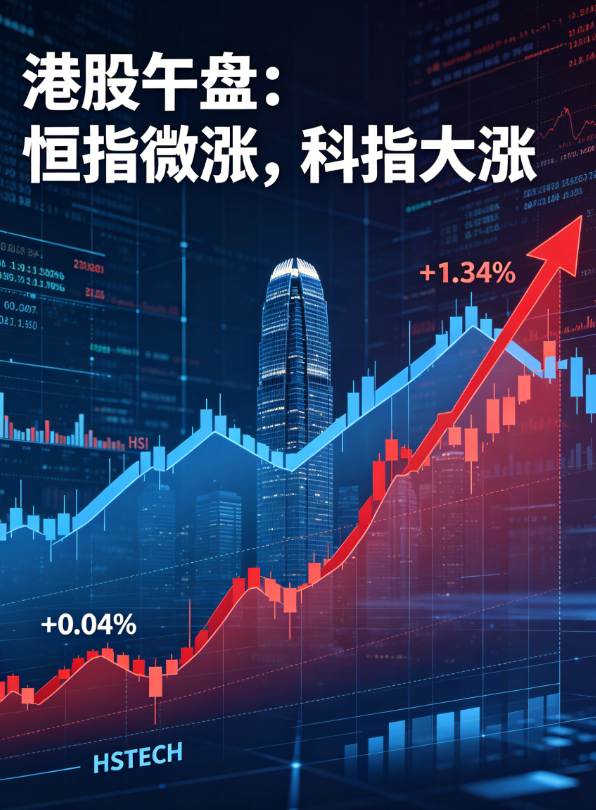
On June 24, 2025, Hong Kong stocks showed divergent trends in midday trading, with the Hang Seng Index and the Hang Seng Tech Index performing differently. By the close, the Hang Seng Index edged up 8.39 points to 23,344.67, up only 0.04%, almost flat from the previous trading day; while the Hang Seng Tech Index was strong, rising 58.9 points to close at 4,458.12, up 1.34%. This data reflects the underlying structural divergence within the Hong Kong market: traditional blue chips were generally weak, while the technology sector showed strong growth momentum. This article will conduct an in-depth analysis of the market from dimensions including constituent stock performance, industry drivers, market sentiment, and future outlook.
1. Market Divergence Pattern: Deep Logic Behind HSI's Slight Gain and Tech Stocks' Lead
1.1 Hang Seng Index: Narrow Fluctuation Dragged by Weighted Stocks
The Hang Seng Index rose only 0.04%, essentially in a sideways state. This phenomenon indicates that although the overall market did not experience significant fluctuations, internal structural adjustments are intensifying. Looking at constituent stocks, WuXi AppTec, SMIC, and WuXi Biologics were among the top gainers; these companies are in the biomedical and semiconductor sectors. In contrast, China Life, Xinyi Solar, and Li Ning suffered larger declines, showing clear capital outflows.
The pressure on traditional financial sectors was an important reason for the HSI's weak performance. China Life, as an insurance leader, saw its stock price decline reflecting market caution about the interest rate environment and the growth outlook of the insurance industry. Currently, mainland interest rates remain low, the pressure on insurers' narrowing spreads persists, and coupled with uncertainty in the pace of macroeconomic recovery, room for valuation repair for insurance stocks is limited. Meanwhile, Xinyi Solar (a photovoltaic glass leader) fell due to industry difficulties like overcapacity and intensified price wars. Li Ning's weakness reflected below-expectations consumer recovery, with the sportswear industry overall facing inventory pressure and intensified competition.
1.2 Hang Seng Tech Index: Semiconductor and AI Dual Engines Drive Gains
In stark contrast to the HSI's sluggishness, the Hang Seng Tech Index surged 1.34%, with technology stocks being the absolute main driver of the market's rise. Hua Hong Semiconductor, SMIC, and Zhipu were among the top gainers among constituents. Hua Hong and SMIC are leading mainland semiconductor manufacturing companies, while Zhipu represents an emerging power in the AI track. This round of tech stock gains was not pure concept speculation but based on fundamental improvement and technological breakthroughs creating substantive positive catalysts.
First, signs of a recovery in the semiconductor industry are clear. Global semiconductor sales have grown month-over-month for several months, with explosive demand for AI chips driving up capacity utilization for advanced nodes; mature nodes also benefit from stable demand from downstream areas like IoT and automotive electronics. SMIC, as a domestic wafer foundry leader, has its capacities fully loaded, and has achieved breakthroughs in advanced packaging technology, leading the market to raise its future earnings expectations. Hua Hong, with its specialty process platforms (e.g., power semiconductors, embedded non-volatile memory), gained favor from capital due to wide applications in new energy vehicles and industrial control.
Second, continuous catalysts emerge in the AI field. Zhipu, as a representative of the AI large model track, has attracted significant attention for its technology iteration and application deployment progress. Recently, the pace of domestic large model filings accelerated, and commercial application scenarios are gradually opening. Zhipu has increased cooperation cases in vertical sectors like finance, healthcare, and education, leading the market to grant a high valuation premium.
2. Analysis of Constituent Stock Rises and Falls: Opportunities and Risks in Sector Rotation
2.1 Top Gainers: Resonance Logic of WuXi AppTec, SMIC, WuXi Biologics
WuXi AppTec and WuXi Biologics, as leaders in the CXO (pharmaceutical R&D outsourcing) industry, rose due to the recovery of global pharmaceutical R&D spending and improved expectations for Chinese innovative drug overseas expansion. With the start of the Fed's rate-cutting cycle, the financing environment for the biomedical primary market has improved, and the growth rate of new orders for CXO companies has picked up. Additionally, R&D breakthroughs by domestic innovative drug companies in frontier areas like ADCs (antibody-drug conjugates) and bispecific antibodies have also driven upstream preclinical and production outsourcing demand. WuXi AppTec and WuXi Biologics, as industry benchmarks, benefit first from the industry recovery due to their leading positions.
SMIC's rise combines both industry beta and company alpha. On one hand, the pace of domestic substitution in the semiconductor supply chain is accelerating, driving strong demand for domestic wafer foundry; on the other hand, SMIC has continuously increased R&D investment in recent years, achieving significant progress in improving advanced node yields and expanding specialty process platforms, earning positive market assessments of its long-term growth.
2.2 Top Losers: Common Plight of China Life, Xinyi Solar, Li Ning
China Life's decline reflects a common issue in the insurance industry: in a low-interest rate cycle, liability costs are rigid while asset-side yields are under pressure, leading to potential spread loss risks. Meanwhile, slowdown in new policy growth and pain from agent team transformation further weighed on the stock price. Xinyi Solar faces the severe challenge of supply-demand imbalance in the photovoltaic industry; industry capacity clearance will take time, module prices remain low, and profit margins are compressed. Li Ning, as a consumer representative, saw its stock price decline reflecting the "wave-like" characteristics of domestic consumption recovery: although the policy side has repeatedly introduced measures to boost consumption, the recovery of consumer confidence and purchasing power still takes time, with high channel inventory and increased discounting in the sportswear industry, leading to profitability pressure.
2.3 Hang Seng Tech Constituents: Focused Opportunities in Divergence
Among Hang Seng Tech Index constituents, Hua Hong, SMIC, and Zhipu led the gains, while MINIMAX-W, Midea Group, and Tongcheng Travel were among the biggest decliners. MINIMAX-W, as a new economy representative, had relatively volatile stock price fluctuations, possibly related to market divergence on its commercialization ability and competitive landscape. Midea Group, as a home appliance leader, may be affected by the weak real estate cycle and slowing demand for home appliance upgrades. Tongcheng Travel's price correction was due to short-term fluctuations in tourism consumption data.
3. Market Sentiment and Macro Environment: Direction of Hong Kong Stocks Amid Long-Short Game
3.1 Liquidity Factors: Southbound Capital vs. Foreign Capital
Hong Kong stocks currently face a complex macro environment. On one hand, the Fed maintaining high rates for longer than expected, with a strong dollar causing capital to flow back to the U.S., putting liquidity pressure on Hong Kong. On the other hand, southbound capital from mainland China continues to flow into Hong Kong, becoming an important stabilizing force. Especially in the technology sector, semiconductor and AI targets are being chased by mainland institutional funds. The tech stock leader on that day partly reflects the precise positioning of southbound capital on structural opportunities.
3.2 Fundamental Expectations: Earnings Recovery Rhythm Determines Sector Divergence
From an earnings perspective, the earnings recovery pace of traditional financial and consumption sectors is significantly slower than that of tech manufacturing. Sectors like semiconductors and CXO have greater earnings elasticity and benefit from support from new industrial cycles. Meanwhile, insurance, photovoltaic, and sportswear industries face their own cyclical difficulties. This fundamental difference determines capital allocation among sectors and explains the divergence between the HSI and HSTECH on that day.
3.3 Policy Signals: Balance Between Tech Autonomy and Consumption Stimulus
Recent policy signals are clear: on one hand, policies like the launch of the third phase of the National Big Fund and the extension of IC tax incentives continue to inject confidence into the semiconductor supply chain; on the other hand, policies to boost consumption and stabilize employment have been intensively introduced, but their effect transmission to corporate earnings still takes time. As an offshore market, Hong Kong stocks are highly sensitive to policy and macro conditions, and capital tends to favor technology tracks with higher policy certainty over traditional sectors more affected by the economic cycle.
4. Future Outlook: Structural Trends Likely to Continue, Focus on High-Flow Sectors
4.1 Short-Term Strategy: Focus on Pullback Entry Opportunities in Tech Leaders
Looking ahead, Hong Kong stocks are likely to maintain a structural pattern. The Hang Seng Tech Index, driven by the dual main lines of AI and semiconductors, is expected to remain relatively strong. Investors can focus on semiconductor targets like SMIC and Hua Hong which have technological barriers and capacity advantages, as well as CXO leaders like WuXi AppTec and WuXi Biologics benefiting from the global pharmaceutical R&D recovery. Additionally, AI application-layer companies like Zhipu may see valuation improvement windows if commercialization surpasses expectations.
4.2 Medium- to Long-Term Perspective: Turning Point for Traditional Blue Chips Still Awaits
For traditional blue chips like China Life, Xinyi Solar, and Li Ning, stock price stabilization requires substantial improvement in industry fundamentals. Before signals like stabilization of interest rates, clearance of photovoltaic overcapacity, and recovery of consumer confidence appear, these sectors may remain under pressure. Investors need patience, focusing on the inflection signals of the companies themselves, rather than blindly bottom-fishing.
4.3 Risk Warning: External Shocks and Internal Volatility
Main risks facing Hong Kong stocks currently include: uncertainty in the Fed's monetary policy shift, geopolitical frictions, and slower-than-expected recovery pace of the mainland economy. These factors may lead to increased short-term market volatility. Investors should reasonably control positions, do diversified allocation, and avoid overconcentration in a single industry or stock.
Conclusion
The divergence in Hong Kong stocks at midday on June 24, 2025, centrally reflects the core characteristics of the current market: tech growth stocks remain active due to triple resonance of industrial cycles, policy support, and earnings flexibility, while traditional blue chips face cyclical difficulties and insufficient valuation repair. The 1.34% gain in the Hang Seng Tech Index contrasted sharply with the 0.04% gain in the Hang Seng Index, a pattern unlikely to reverse in the short term. For investors, they should follow market trends, tilt allocation toward high-flow tracks like semiconductors, AI, and pharmaceutical CXO, while prudently treating valuation traps in traditional industries. Only by grasping the main line of industrial upgrading and technological innovation can they obtain stable returns in the structural market of Hong Kong stocks.