For the precious metals market, the Fed's rate path has never been just one ordinary member among many macro variables—it is the anchor of the entire pricing system. When signs of an inflection point in the rate cycle emerge, the valuation logic of gold and silver is often the first to be rebuilt. In this issue, Kuayang Jindao Research Institute analyzes the pricing mechanisms of precious metals during the rate-decline phase from three dimensions—real interest rates, the dollar cycle, and term premium—and explores their transmission paths to Asian Chinese-concept gold mining assets.
1. Real Interest Rates: The First Principle of Gold Pricing
As a non-yielding asset, gold's opportunity cost of holding can be characterized by the real interest rate (nominal rate minus inflation expectations). Looking back over half a century of market history, gold prices show a significant negative correlation with real yields on US Treasuries: when real rates are suppressed or even turn negative, the opportunity cost of holding gold declines and capital seeks alternative assets that hedge against inflation and currency depreciation; conversely, during phases of rapidly rising real rates, gold often comes under pressure.
This logic was fully validated in the 2019–2020 easing cycle: nominal rates fell rapidly, massive liquidity injections drove real rates deeply negative, and gold prices hit historic highs. In contrast, during the aggressive rate-hike phase of 2022–2023, despite additional support from geopolitical risks and reserve diversification across countries, gold's gains were still clearly constrained by rising real yields. Understanding this pricing anchor is the starting point for judging the nature of the current precious metals rally.
2. Three Transmission Paths in the Rate-Decline Phase
Path One: The Race Between Nominal Rates and Inflation Expectations
At a rate inflection point, what the market truly watches is not the nominal size of policy rate cuts but the direction of real rates. If inflation expectations fall faster than nominal rates, real rates may actually rise, making a trending gold market hard to achieve; only when nominal rates decline faster than inflation expectations can falling real rates open room for gold prices. Historically, gold's muted performance in the early stages of multiple easing cycles followed by acceleration later stems precisely from this timing gap in the race.
Path Two: The Weakening Effect of the US Dollar Index
The dollar and gold are both internationally priced assets with an inverse, seesaw relationship. When the Fed enters an easing cycle while other major central banks remain relatively restrained, narrowing rate spreads typically weigh on the US Dollar Index, giving dollar-denominated gold a currency-level tailwind. Notably, the structural trend of global FX reserve diversification in recent years has also been marginally weakening the foundation of dollar strength; combined with the rate cycle, this factor amplifies gold's elasticity.
Path Three: Term Premium and the Long-Term Pricing of the Debt Problem
Beyond short-term policy rates, the term premium within long-end rates is becoming an increasingly important variable. Government debt in major economies keeps climbing, and market concerns over fiscal sustainability push up long-term term premia, which typically accompany rising demand for inflation hedges. As the ultimate reserve asset free of credit risk, gold in this environment gains not merely a rate dividend but compensation for the credit discount of the monetary system. This also explains why gold has stayed strong even in high-rate phases: rates price the short-term opportunity cost, while credit prices the long-term value.
3. Silver: The Dual-Engine Resonance of Financial and Industrial Attributes
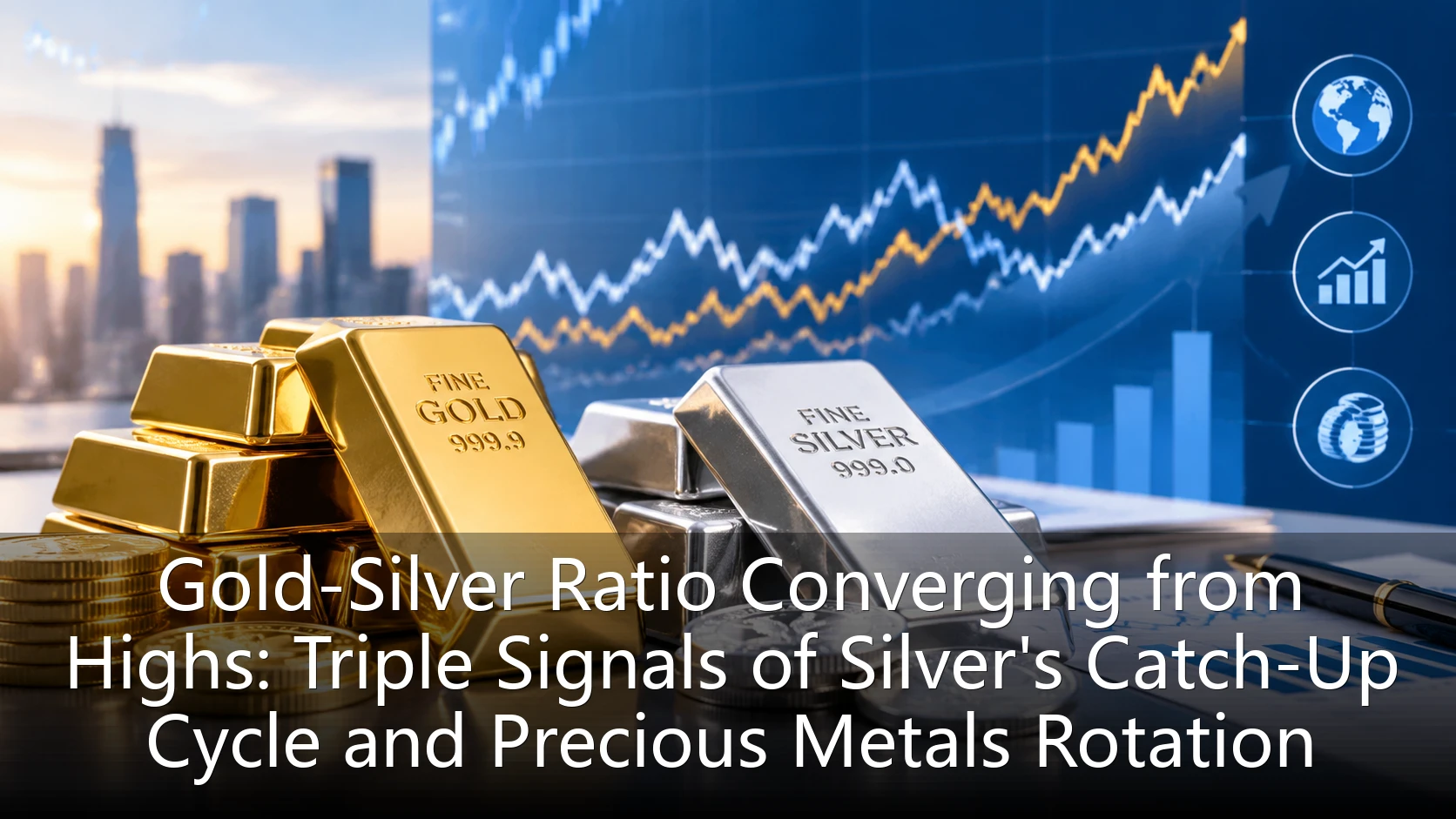
Compared with gold, silver often reacts more sharply to the rate cycle. On one hand, silver shares gold's monetary-financial attributes, so falling real rates likewise lower its cost of holding; on the other, roughly half of silver demand comes from industry, and easing cycles usually accompany improving economic expectations, with expanding demand from photovoltaics, power electronics, and other emerging industrial sectors providing independent support for silver prices. Historical experience shows that in the mid-to-late stages of easing cycles, silver's rally elasticity often exceeds gold's, and the convergence of the gold-silver ratio is the classic signal for observing this phase. For investors, the gold-silver ratio can be viewed as a cycle thermometer: a decline from high levels often means recovering economic expectations and the spread of the precious metals bull market into silver.
4. Transmission to Asian Chinese-Concept Gold Mining Assets
The rate cycle's impact on precious metals ultimately maps onto equity assets along the industry chain. For Asian Chinese-concept gold mining companies, the improvement brought by falling rates is twofold: first, a higher gold price center directly thickens mining profits, and the operating leverage of mining companies makes profit elasticity far greater than the gold price itself; second, a loose monetary environment lowers discount rates, systematically lifting the valuations of capital-intensive, long-cycle mining projects. When rising volume and price meet valuation expansion, the market's familiar Davis Double Play gains a solid macro foundation.
It should be emphasized that the elasticity of mining stocks is not released at a uniform pace. In the early stage of brewing rate-cut expectations, rising gold prices often lead miners' earnings realization, and share prices may show valuation-first characteristics; during earnings season, data on output, costs, and capital expenditure will become the key test of the thesis. Investors should distinguish between the two phases—valuation repair driven by rate expectations and the performance-driven double play—and adopt different participation rhythms and position strategies.
5. Risk Warnings and Watchlist
- Inflation stickiness risk: if stalled disinflation forces rates to stay higher for longer, repeated swings in real rates will bring periodic gold price pullbacks;
- Dollar reflexivity risk: safe-haven buying triggered by global risk events may push up the dollar in the short term, pressuring dollar-denominated precious metals;
- Expectation over-discounting risk: if easing expectations are already fully priced in, policy delivery may instead trigger profit-taking as the good news is exhausted;
- Mining-specific risks: FX volatility, policy changes in resource countries, and cost inflation may erode miners' profit elasticity.
Investors are advised to continuously track five high-frequency indicators: the real yield implied by 10-year TIPS, the US Dollar Index, the rate-cut probability implied by interest rate futures, changes in precious metals ETF holdings, and the gold-silver ratio. Together these five indicators form the dashboard for trading precious metals in the rate cycle; any abnormal change in any one of them deserves heightened vigilance.
6. Conclusion: Finding an Anchor of Certainty in the Pendulum of Rates
The rate cycle is like a pendulum, and its swing direction determines where capital flows. As easing expectations gradually become consensus, the pricing logic of precious metals will switch from rate suppression to credit hedging, and once established, this switch often lasts several quarters. For allocation-oriented capital, gold remains the ballast in portfolios against rate and credit risks; for flexible capital, silver and quality mining stocks with production growth offer offensive options in the mid-to-late bull market. Kuayang Jindao Research Institute will continue tracking the details of the linkage between the Fed's policy path and the precious metals market, helping investors seize the initiative at the cycle's key inflection points.