Zhipu vs. Anthropic's AI Programming Battle: Open Source vs. Closed Source Showdown
Introduction: The Trillion-Dollar Market Cap Mystery
In June 2025, Chinese AI company Zhipu (02513.HK) experienced market cap roller-coaster fluctuations. On June 22, its stock price surged 15.09%, with market cap breaking through HKD 1.07 trillion; the next day, it pulled back 9.96% to HKD 967.5 billion. From tens of billions to trillions in just half a year, the market even described it as "equivalent to three Meituans or four JDs."
Supporting this valuation premium is Zhipu's scarcity in the AI programming field—as a counterpart to Anthropic, its GLM-5.2 model achieved the top ranking among globally available models in the blind test front-end development evaluation system Code Arena, with millions of users worldwide participating, placing it ahead of domestic peers. However, Zhipu chose a path completely different from Anthropic: open source.
1. The Clash Between "The Cathedral" and "The Bazaar"
Programmers have long circulated the "Bible" The Cathedral and the Bazaar, whose title metaphorically describes two development models: the former managed in a closed environment by a dedicated team, the latter relying on open collaboration over the Internet. The book's famous Linus's Law states: "Given enough eyeballs, all bugs are shallow."
When Anthropic's "cathedral" blocked global access to two of its latest models due to a U.S. Commerce Department ban, Zhipu's "bazaar" paved the road at everyone's feet. This is Zhipu's strategic logic for choosing open source: open-sourcing GLM-5.2 under the most permissive MIT license, allowing free commercial use, precisely "grabbing users" as Anthropic locked down.
2. Snipping Fable 5: A Zero-Frame Handoff Relay Race
For a long time, Anthropic has been one of the strictest U.S. large model companies regarding regional access controls. From ownership lock escalation in September 2025, to the introduction of identity verification mechanisms in April 2026, and on June 9, 2026, releasing its strongest models Claude Fable 5 and Claude Mythos 5, only to have the U.S. Commerce Department ban all foreign nationals from accessing them three days later on "national security" grounds—these blockade measures have been intensifying step by step.
As soon as the ban was announced, Zhipu responded almost at "zero-frame start," publishing an article titled "To Developers: GLM-5.2 Fully Open, Frontier Intelligence Belongs to Everyone." Its statement cut to the chase: "At a time when some frontier models suddenly become unavailable, we choose to believe in another path: frontier intelligence should not belong only to a few, nor be reclaimed at any time by a few rules."
This is not the first time Zhipu has relayed to fill the gap around Anthropic's blockades. In September 2025, Zhipu quickly launched a "Special Relocation Plan for Claude API Users" in response to Anthropic's escalated blockade policies. Behind these two precise stops is a microcosm of the deep struggle between the two routes of open source and closed source for global large models.
3. The Rise of the Open Source Route: From Follower to Competitor
Since DeepSeek "burst onto the scene" sparking an open source wave, China's large model industry has gradually formed a competitive path of "capability catch-up + open source ecosystem." For most domestic manufacturers, with technology and global commercialization barriers not yet fully established, open source has become a key path to expand the developer base and increase model penetration.
After a year and a half of accumulation, the share of Chinese model calls on OpenRouter, the world's largest model aggregation platform, has risen from about 1.2% at the end of 2024 to over 50%. In last week's usage ranking on the platform, models from DeepSeek, Xiaomi, MiniMax, and Tencent took the top four positions. As the model capability gap narrows and the cost-performance advantage continues to expand, the competitiveness of the open source route continues to strengthen.
Dongfang Securities believes that open source models, with their characteristics of open weights, autonomous control, and local deployment, become a better solution to avoid geopolitical risks and ensure business continuity. In the future, downstream users may no longer purely chase model performance but will shift more toward models that are stably available, autonomously controlled, and continuously accessible.
4. The Match Point of AI Programming: Where Are Resources Concentrated?
AI programming, as possibly the shortest path to AGI, has attracted enormous market attention. Anthropic officially announced the confidential submission of its IPO prospectus draft and completed a $65 billion Series H financing at a post-money valuation of $965 billion, formally surpassing OpenAI as the world's highest-valued AI company. Its CEO Dario Amodei disclosed that annualized revenue in May 2026 exceeded $44 billion, with revenue growing approximately 10x per year.
Notably, AI programming is a typical winner-take-all market. Users are extremely sensitive to performance, and switching costs are very low. According to an April research report from UBS, Moonshot AI's Kimi series focuses on multi-agent collaboration and complex task decomposition; MiniMax emphasizes full-stack multimodal capabilities; DeepSeek focuses on mathematical reasoning, logical reasoning, and long-context processing. Meanwhile, Zhipu is going all-in on AI programming, publicly revealing: "Since the beginning of 2025, we have invested almost all our efforts in attacking Coding."
This choice aligns with Anthropic's strategy. UBS believes that the two companies' model development strategies are highly consistent—both are focused on coding capabilities at the model layer and have relatively low attention to multimodal technologies (i.e., audio and video generation). In UBS's view, the long-horizon task-solving ability in AI coding is crucial for real-world software development.
Conclusion: The Unknown Path to AGI
Competition in the AI programming field is not only a technological contest but also a battle of business models and strategic choices. Zhipu's "bazaar" open-source competition against Anthropic's "cathedral" closed-source strategy—who will ultimately win? It is currently unknown.
When asked "When will China's large models reach Fable-level capability?" independent researcher Teortaxes gave a time lag judgment of 7 months, and Musk immediately responded that it might be around the first quarter of 2027. Zhipu CEO Tang Jie stated directly: "It won't take that long."
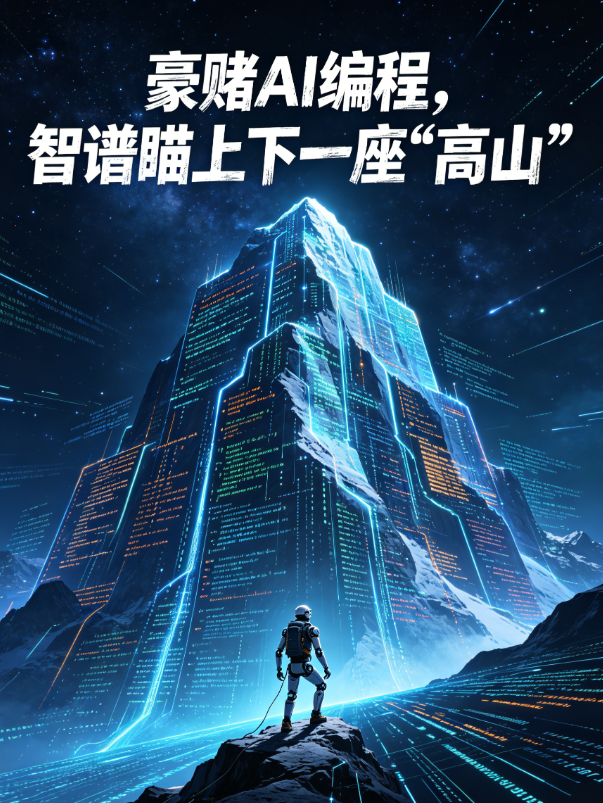
Code is not yet AGI; there are many more mountains to climb on the road to AGI. Zhipu has already set its next direction: "Fully Autonomous Intelligent Agent Systems." Regardless of which route ultimately prevails, this game about technological freedom and sovereign control has already become an important watershed in the development of the AI industry.